Rahu Puja
The Rahu Puja is a traditional Vedic ritual for Rahu (the north lunar node), performed in your name with a sankalpa from your birth details, Rahu mantra japa and the offerings associated with Rahu (the north lunar node). In Vedic astrology Rahu (the north lunar node) is linked with ambition, restlessness, confusion, sudden change and foreign connections, so this puja is usually considered when Rahu (the north lunar node) is under pressure in your chart.
Read the video transcript
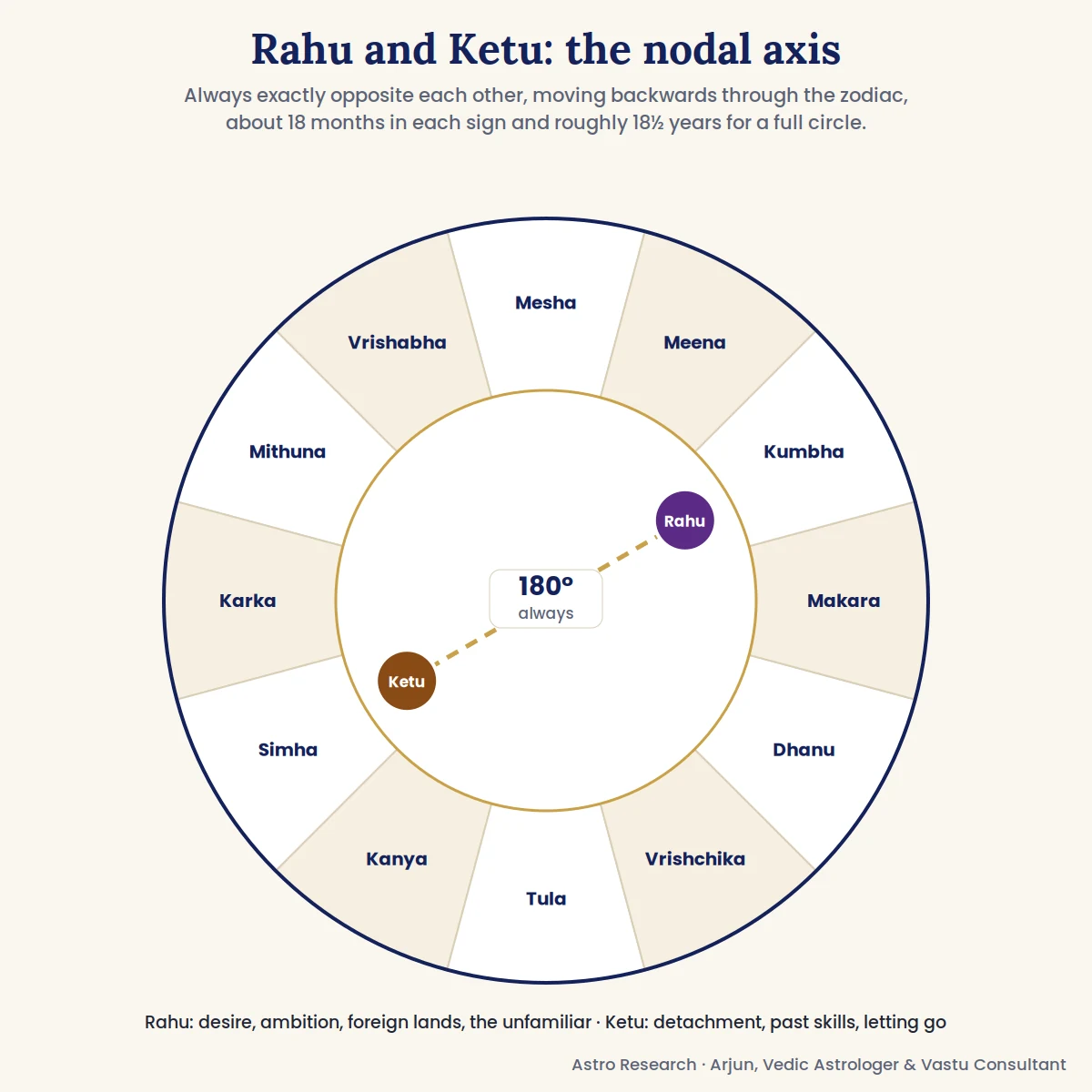
- Not physical planets: Rahu and Ketu are the two points where the Moon's path crosses the Sun's path.
- Always opposite: they sit exactly 180° apart, so whatever Rahu activates, Ketu balances on the other side.
- Moving backwards: they travel in reverse through the zodiac, about 18 months in each sign.
- Pull and release: Rahu pulls toward the new, the foreign and the ambitious. Ketu loosens our grip on what is finished.
- Why timing matters: in a Rahu or Ketu period, a chart check shows which houses are being stirred and how to work with them.
See how to book the Rahu Shanti Puja →
When is a Rahu Puja considered?
A Rahu Puja is usually considered when your birth chart, current Dasha or a transit shows Rahu (the north lunar node) under strain. Common indications include:
- You are running a Rahu Mahadasha or Antardasha
- Rahu is joined by the Sun, Moon or Jupiter
- Rahu is transiting a sensitive point in your chart
Arjun checks your chart first, because the same placement can be strong or weak depending on the rest of the chart. If a puja isn’t needed, he’ll tell you.
Rahu at a glance
Rahu’s traditional day is Saturday, its presiding deity is Goddess Durga, and its beej mantra is “Om Bhraam Bhreem Bhraum Sah Rahave Namah”. These are the classical associations a Rahu Puja draws on:
| Graha | Rahu |
|---|---|
| Day | Saturday |
| Presiding deity | Goddess Durga |
| Beej mantra | Om Bhraam Bhreem Bhraum Sah Rahave Namah |
| Traditional japa count | 18,000 recitations |
| Colour | Smoky grey and dark blue |
| Traditional offerings (daan) | Black sesame, a blanket, coconut and mustard oil |
| Associated gemstone | Hessonite (Gomed); wear only on personal advice |
How is the Rahu Puja performed?
The puja is performed on your behalf, usually on a Saturday, during an auspicious window, so you don’t need to be present.
- Sankalpa: your full name, date, time and place of birth are used to set the ritual intention.
- Invocation: Lord Ganesha is invoked first, followed by Goddess Durga.
- Mantra japa: the Rahu beej mantra is recited by the priests.
- Havan and offerings: a fire ritual with the traditional samagri and daan for Rahu (the north lunar node).
- Confirmation: you receive confirmation once the puja is complete.
Astrologer’s insight from Arjun
“A puja works alongside the way you live. I always pair a Rahu Puja with one or two simple daily practices, so the remedy becomes part of your routine rather than a one-off event.”
Frequently asked questions
Do I need to attend the Rahu Puja?
No. It is performed in your name using your sankalpa, a long-established Vedic practice. A live video link can be arranged on request.
Is a Rahu Puja right for me?
It depends on your chart. Arjun checks where Rahu (the north lunar node) sits, your current Dasha and the major transits before recommending it. A consultation is the best place to start if you’re unsure.
What else can I do alongside the puja?
Simple daily remedies help. See the Rahu remedies guide for mantra, daan and lifestyle practices.
Book your Rahu Puja
Message Arjun on WhatsApp (0416 465 395) or call (02) 8526 6969 to arrange your puja. Not sure it’s the right remedy? Book a consultation and Arjun will check your chart first, or compare all options on the Book a Puja page.
Pujas and remedies are traditional spiritual practices offered in good faith. Their effects are personal and can’t be guaranteed, and they are not a substitute for medical, legal, financial or psychological advice. See our disclaimer.
When Rahu is the pressure point
Rahu brings sudden change, ambition and pull toward the unfamiliar, including moving overseas. In a Rahu period people describe confusion, restlessness and upheaval, and many migrants tell me about visa and residency uncertainty. Remedies steady the mind so good decisions can be made.
What people tell me
- Sudden career upheaval or confusion about direction.
- Restlessness, poor focus and no peace of mind.
- Visa, residency and migration stress, and worry about Kaal Sarp Dosha.
The traditional remedy
Rahu Shanti Puja, or a Kaal Sarp Dosha Nivaran Puja where that yoga is present, with Durga worship, Om Raam Rahave Namah on Saturdays and less overstimulation.
The Vastu zone to look at
South-West: Rahu's zone (Nairutya). A South-West entrance or a cut corner there is the classic issue; soften the threshold with a brass strip or plants and keep the area heavy and closed.
Rahu Shanti Puja → Book a consultation with Arjun
Everyday remedies for Rahu · All nine planets together: Navagraha Shanti Puja
Questions people ask about Rahu
How do I get through Rahu Mahadasha?
Keep a simple routine, avoid shortcuts and speculation, and check decisions with someone you trust. Durga worship and a Rahu mantra help many people. Rahu often gives big gains when you work with its hunger for growth rather than against it.
Does Rahu in the 12th house mean I will settle abroad?
Rahu in the 12th is a classic sign of foreign connections and life overseas, and it is common in the charts of people who migrated. Whether you settle permanently depends on the 4th house and Dasha timing as well.
Can astrology help with my Australian visa or PR?
It can show when a period is more supportive and help you stay steady while you wait. It can't change an application outcome. For visa advice, please use a registered migration agent or the Department of Home Affairs.