Everyone Is Reading Their Horoscope Wrong. Here’s What a Vedic Astrologer Actually Looks At.

Most horoscopes you read online are based on your Sun sign alone — a single data point out of at least a dozen variables a properly trained Vedic astrologer actually uses to read a chart. Vedic astrology (Jyotish) instead maps the exact degree of your Moon, your rising sign (Lagna), your lunar mansion (Nakshatra), and the planetary periods (Dashas) active at the precise moment of your birth, producing a reading that belongs to you specifically rather than to the twelfth of humanity born in the same five-week window. If you’ve ever read your daily horoscope and thought, “that doesn’t sound like me at all,” you weren’t imagining it. You were reading a system engineered for mass publication, not personal precision — and in fifteen years of consulting clients across Sydney, Melbourne and Brisbane, this is the single most common misunderstanding I encounter. So let’s fix it properly, in full technical detail.
Why Sun-Sign Horoscopes Only Tell Part of the Story
Sun-sign horoscopes sort all 8 billion people on Earth into just twelve categories based purely on the sun’s position on your birth date, while ignoring the exact time and place you were born — which means two people born on the same day in Sydney and in Stockholm receive an identical horoscope despite having completely different rising signs, Moon placements and planetary houses. That’s not a simplification; it’s a different question being answered. A newspaper horoscope answers “what does today look like for the roughly 650 million people born under this sign?” A Vedic reading answers “what does today look like for you, specifically, given the sky as it actually stood the moment you took your first breath?”
The modern habit of reading a single-paragraph horoscope traces back to British astrologer R.H. Naylor’s 1930 column in the Sunday Express, written for Princess Margaret’s birth and expanded into a general sun-sign feature purely because it was fast to produce and easy for a mass audience to self-identify with. It was designed as entertainment journalism, not as a diagnostic tool — and that origin still shapes how most people encounter astrology today. In Vedic practice, the Sun (Surya) is only one of nine classical grahas (planetary bodies) considered, alongside the Moon, Mars, Mercury, Jupiter, Venus, Saturn, and the two lunar nodes, Rahu and Ketu. The Sun is rarely the most decisive factor in a person’s temperament, career timing or relationships — the Moon (Chandra), the Ascendant (Lagna) and the ruling planetary period (Dasha) usually matter far more.

What a Vedic Astrologer Actually Looks At
A qualified Vedic astrologer builds your reading from four core pillars — the Lagna (rising sign), the Rashi (Moon sign), your Nakshatra (lunar mansion), and the current Dasha (planetary period) — each of which requires your exact birth time and location to calculate correctly, which is why a proper consultation always starts with your birth certificate details, not just your date of birth. Together these four pillars do more work than the Sun sign ever could, because they describe not just your personality in the abstract, but the specific timeline your life is likely to follow.
The Lagna (Ascendant) — Your Rising Sign
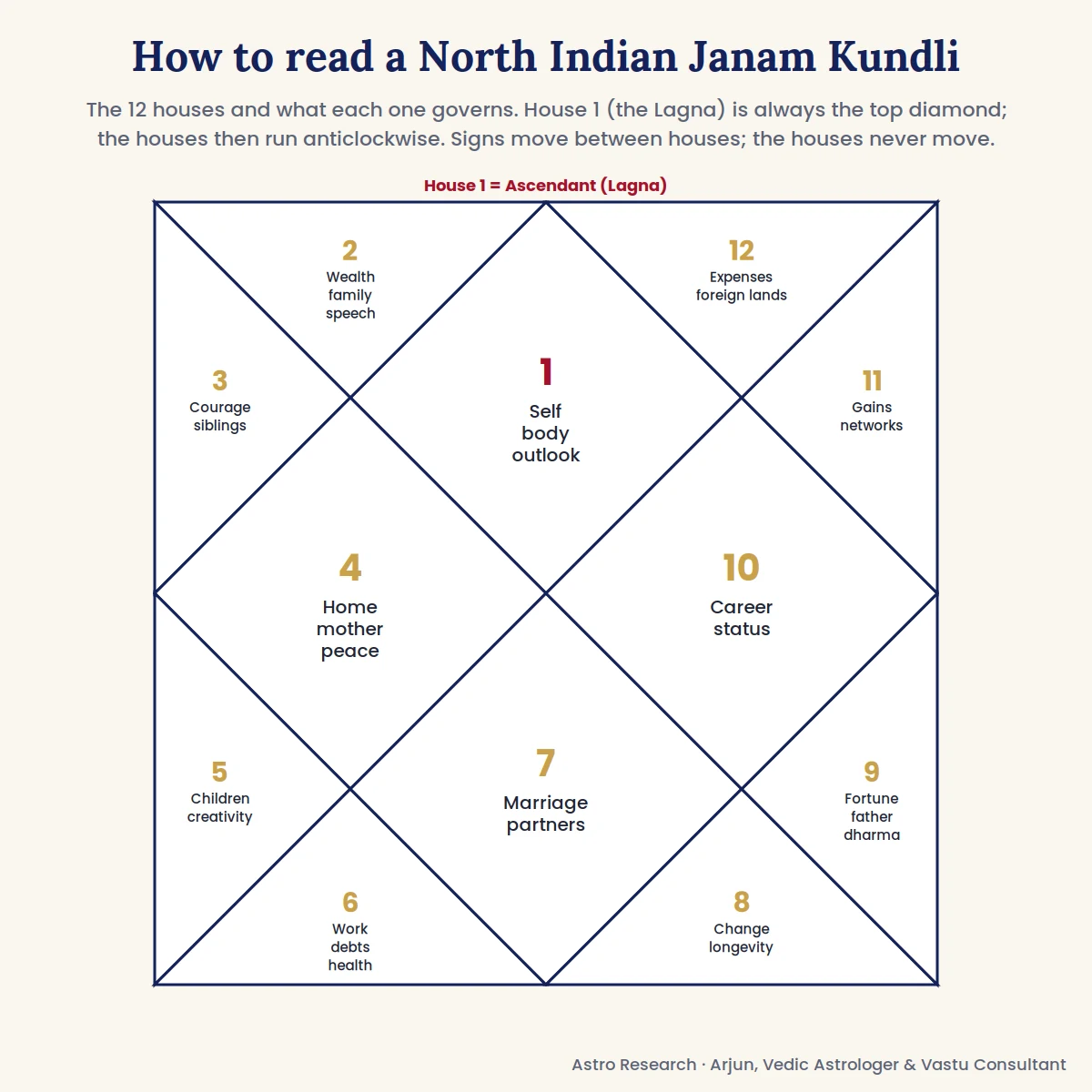
The Lagna is the zodiac sign rising on the eastern horizon at the exact moment of your birth, and it changes roughly every two hours — which is why two siblings born on the same day can have entirely different charts. It sets the first house (Bhava), from which every other house — career, marriage, wealth, health — is measured. It governs your outward temperament, your physical constitution, and how the world perceives you within the first few moments of meeting you. This is often the single biggest reason a Vedic reading feels startlingly accurate where a Sun-sign horoscope felt generic.
The Rashi (Moon Sign) — Your Emotional Core
Where Western astrology treats the Moon as a secondary factor, Vedic astrology treats it as arguably the most important placement in the chart — so central that most traditional Jyotish predictions, including monthly transit (Gochar) forecasts, are calculated from your Rashi rather than your Sun sign. The Moon moves through a new sign roughly every two and a half days, giving it far more precision than the Sun’s month-long transits. It governs your emotional instincts, your subconscious patterns, and how you process stress — which is why clients often tell me their Vedic Moon-sign reading feels more like a psychological profile than a horoscope.
The Nakshatra — Your Lunar Mansion
This is the pillar most Western readers have never heard of, and it’s arguably the most precise one we have. The zodiac’s 360 degrees are divided into 27 Nakshatras — lunar mansions of 13°20′ each, running from Ashwini through Revati — and every Nakshatra carries its own ruling planet, presiding deity, and symbolic character, independent of which of the twelve signs it falls inside. Two people can share the same Moon sign yet fall in entirely different Nakshatras, which often explains why two “identical” Moon-sign readings can describe noticeably different personalities. Your Nakshatra also sets the starting point of your Vimshottari Dasha sequence.
The Dasha — Your Planetary Timeline
This is the piece with no real Western equivalent, and it’s usually what clients find most valuable. The Vimshottari Dasha system divides your life into a fixed sequence of planetary periods — a Saturn Mahadasha might run for nineteen years, a Jupiter Mahadasha for sixteen — each sub-divided into shorter Antardasha (Bhukti) periods ruled by the others. A skilled astrologer also weighs each planet’s Shadbala, its measured six-fold strength, to judge whether a Dasha lord will deliver its themes smoothly or under strain. This is what allows an astrologer to say not just “you are ambitious” but “your career-focused period began eighteen months ago and will intensify around March next year.” It converts astrology from a description of character into an actual timeline — exactly the tool I used in the case study below.

The Historical Divide Between Western and Vedic Astrology
Western astrology uses the tropical zodiac, fixed to the seasons, while Vedic astrology uses the sidereal zodiac, fixed to the actual visible constellations — and because the Earth wobbles slowly on its axis (a 26,000-year cycle called the precession of the equinoxes), the two systems have drifted roughly 24 degrees apart over the last two thousand years, meaning your Western Sun sign and your Vedic Sun sign are very often different signs entirely. This single fact explains why so many people say their Vedic reading “describes someone else” on first glance, before it turns out to describe them far better than their Western sign ever did.
Both systems started from the same place. Around 130 BCE, the Greek astronomer Hipparchus first documented the precession of the equinoxes, and Western astrology chose to anchor its zodiac to the seasons — the tropical zodiac, where 0° Aries is permanently fixed to the March equinox regardless of where the constellations have since drifted. Vedic astrology took the opposite decision: it kept the zodiac anchored to the actual constellations as they appear in the sky, a system called sidereal. The offset between the two, known as the ayanamsa, currently sits at approximately 24 degrees and continues to grow by about one degree every 72 years. This is not a matter of one tradition being “right” and the other “wrong” — they are simply measuring against different reference points, the way a nautical chart and a road map both accurately describe the same coastline. But it does mean the two systems will keep diverging, and it’s the entire reason someone can be a Western Leo and a Vedic Cancer at the same time. Both are true. They’re just answering different questions.
Sun-Sign Horoscope vs. a Full Vedic Reading: The Expanded Comparison
A newspaper horoscope uses one variable (your Sun sign) and applies it to roughly 650 million people at once, while a full Vedic reading uses your exact birth time, date and location to calculate at least nine planetary positions, twelve house placements, your Nakshatra and your current Dasha period — producing a result that is, statistically, unique to you. The table below breaks down exactly what each approach can and can’t tell you.
| Feature | Sun-Sign Horoscope | Full Vedic (Jyotish) Reading |
|---|---|---|
| Data required | Birth date only | Exact birth date, time & location |
| Zodiac system | Tropical (season-based) | Sidereal (constellation-based) |
| Planetary factors used | Sun only | 9 classical grahas + Lagna + Nakshatra + 12 houses |
| Divisional charts used | None | Navamsa (D9) for marriage, Dashamsa (D10) for career, and others |
| Personalisation | Shared by ~650 million people | Statistically unique to you |
| Timing precision | Daily/weekly generic trends | Dasha & Gochar periods pinpointing years, months and windows |
| Remedial guidance | None | Gemstones, mantras, Vastu & timing adjustments where indicated |
| Best used for | Light daily entertainment | Career timing, relationship compatibility, major decisions |
FEATURED CASE STUDY
How a Full Vedic Reading Changed a Sydney Marketing Manager’s Career Decision
A 34-year-old marketing manager came to me in genuine distress after being offered a promotion she had chased for three years — the title, the salary, the corner office — only to feel a wave of dread instead of relief the moment the offer landed, with no rational explanation for the feeling and a decision deadline of one week. She had read her Sun-sign horoscope that morning, which told her the stars favoured “bold career moves” that month. It offered her nothing about why her gut was screaming the opposite.
When I built her full chart from her exact birth time in Parramatta, the picture was completely different from what the generic horoscope suggested. She was six months into a Saturn Mahadasha — a nineteen-year planetary period that, for her chart, had begun with Saturn sitting in her 10th house, the house of career and public standing. Saturn in the 10th during its own Mahadasha is a classically demanding placement: it rewards patience, structural groundwork and long-term positioning, and it punishes rushed, ego-driven leaps. Layered on top of that, she was in the early months of a Jupiter Antardasha — a sub-period where Jupiter, the natural karaka for wisdom and expansion, was activating from her 2nd house of income and personal values, not her 10th house of title and status. Her Moon sat in Uttara Ashadha, a Nakshatra associated with slow, earned authority rather than sudden elevation — which lined up precisely with what her Dasha was already telling me.
The Turning Point: Her transiting Saturn was also moving through her natal Moon sign that same month — the classic opening phase of a Sade Sati cycle. Two independent layers of the chart pointing at the same caution is exactly what tells an astrologer a signal is real, not noise.
She negotiated instead for a formalised scope, a six-month review point, and a retained title in her existing, stable team while the ambiguous new structure proved itself. Eight months later, the restructured team was dissolved and folded back into two other departments — the people who took the original promotion were reassigned twice within a year. She, by contrast, used that same Jupiter Antardasha window for exactly what it was built for: she completed a postgraduate certification, renegotiated her base salary, and stepped into the restructured, stabilised version of the role eleven months later, on her own terms and at a higher band than the original offer. Her Saturn Mahadasha continues for another eleven years, and I’ve since mapped her next major shift: a Mercury Antardasha beginning in two years, activating her 3rd house of communication — which looks very likely to bring a move into a more senior, externally-facing strategy role.

A horoscope would have told her the stars favoured a bold move. Her actual chart told her which kind of bold move her current planetary period was built to reward — and, just as importantly, which kind it wasn’t. This is one of dozens of readings like it.
Read More Client Success Stories
Frequently Asked Questions
➕ What happens if I don’t know my exact birth time?
You’re not out of options, but precision drops for time-sensitive factors like your Lagna and house cusps. Your birth certificate or hospital records usually have the exact time; if neither is available, I can use a technique called chart rectification, working backwards from major confirmed life events — a marriage, a career change, a relocation — to narrow the likely birth window down to a workable range. Your Moon sign, Nakshatra and Dasha sequence stay reliable even with an approximate time, since they shift far more slowly than the Lagna does.
➕ Why does my Vedic star sign seem different from my Western star sign?
This comes down to the roughly 24-degree gap between the tropical zodiac (used in Western astrology, fixed to the seasons) and the sidereal zodiac (used in Vedic astrology, fixed to the visible constellations). Because of the slow 26,000-year wobble in the Earth’s axis called the precession of the equinoxes, the two zodiacs have drifted apart over the last two millennia. It’s common to be, for example, a Western Leo and a Vedic Cancer at the same time — both are correct, they’re just measured against different reference points.
➕ What exactly is a Dasha period, and why does it matter more than my star sign?
A Dasha is a fixed-length planetary period — calculated from your Moon’s exact degree within its Nakshatra at birth — during which one planet’s themes dominate your life’s circumstances. The full Vimshottari Dasha cycle runs 120 years and is divided among the nine classical planets in fixed proportions (Saturn gets 19 years, Jupiter 16, and so on), each further divided into smaller Antardasha sub-periods. Your star sign describes a fixed personality trait; your Dasha describes what chapter of your life you’re actually in right now. It’s the closest thing Vedic astrology has to a timeline, which is why it matters far more for decisions about timing — career moves, relationships, major purchases — than any single sign ever could.
➕ How often should I actually get a Vedic astrology reading done?
There’s no need to return constantly — a thorough initial reading, covering your Lagna, Rashi, Nakshatra and full Dasha sequence, typically holds up for years, since Dasha periods themselves often run for well over a decade. The right time to come back is when you’re approaching a genuine crossroads: a Dasha or Antardasha change, a major career or relationship decision, or a period where your gut and the generic advice around you clearly disagree, the way it did for the client in the case study above. Think of it less like a monthly check-in and more like consulting the map before a major turn in the road, not after every step.
About the Author
Arjun is a Vedic Astrologer and Vastu Consultant at Astro Research, based in Sydney, where he has spent over fifteen years combining classical Jyotish training with practical, modern consultations for clients across Australia. He specialises in career timing, relationship compatibility and Vastu corrections for the home and workplace.
Related Reading
- Forget Your Sun Sign — Your Nakshatra Is the Placement That Actually Explains You
- Why “Bad Years” and “Good Years” Aren’t Random — The Dasha System Explains the Pattern
- The 10th House Isn’t Just “Career” — It’s How the World Sees You
Recommended Remedies
If a Saturn-led chapter like the one above is testing you right now, these are worth exploring:
Curious what your own Lagna, Moon sign, Nakshatra and current Dasha period actually say about the decision in front of you?
I offer an initial consultation to walk you through your real birth chart — not a generic Sun-sign summary — so you can make your next move with clarity instead of guesswork.