

Everyone Treats Rahu and Ketu as “Bad Planets” — That’s Exactly Why Their Transits Blindside You
By Arjun — Vedic Astrologer & Vastu Consultant, Astro Research, Sydney
Read the video transcript
- Not physical planets: Rahu and Ketu are the two points where the Moon's path crosses the Sun's path.
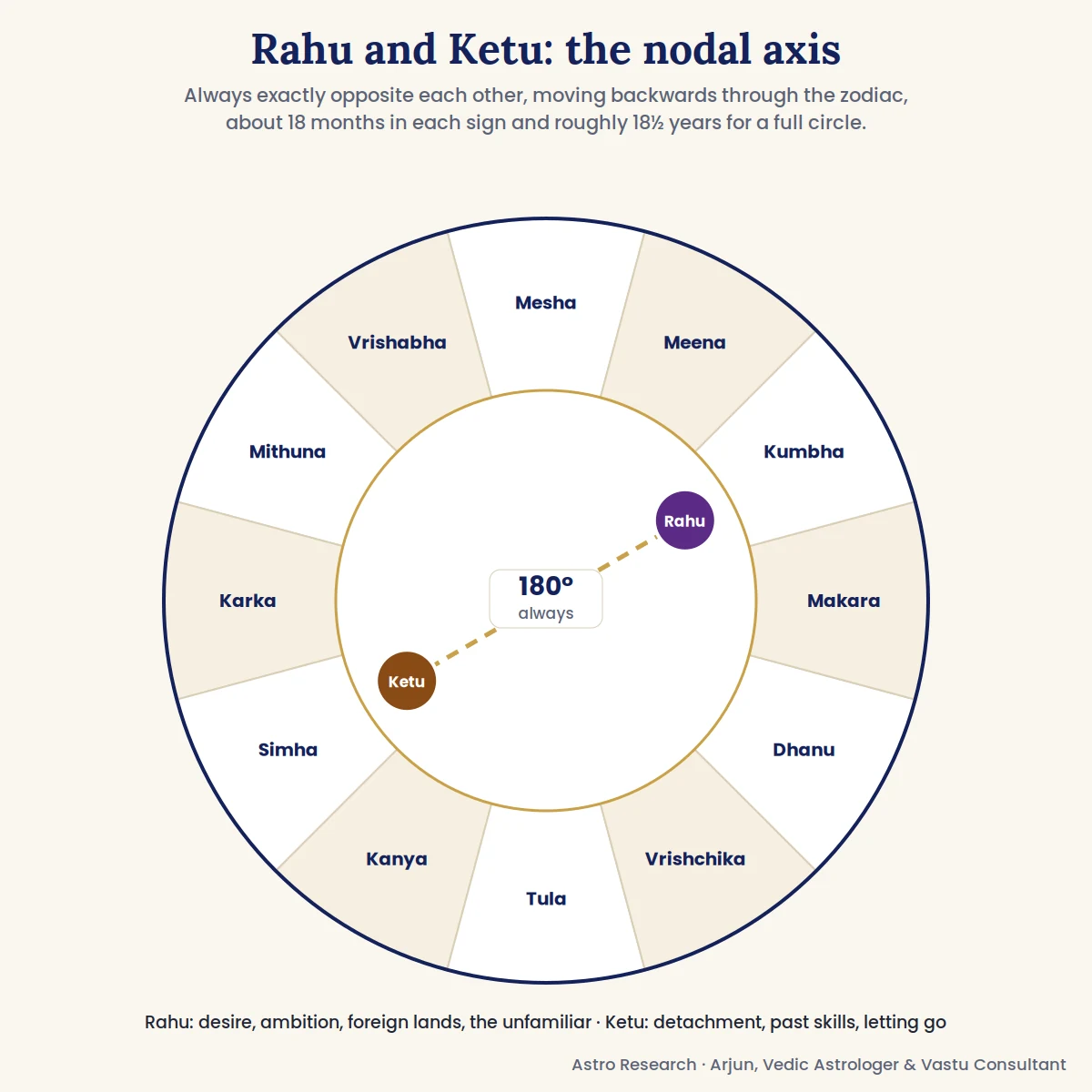
- Always opposite: they sit exactly 180° apart, so whatever Rahu activates, Ketu balances on the other side.
- Moving backwards: they travel in reverse through the zodiac, about 18 months in each sign.
- Pull and release: Rahu pulls toward the new, the foreign and the ambitious. Ketu loosens our grip on what is finished.
- Why timing matters: in a Rahu or Ketu period, a chart check shows which houses are being stirred and how to work with them.

Rahu and Ketu are not malefic planets in the way Mars or Saturn can be — they are shadow points, mathematical nodes marking where the Moon’s path crosses the Sun’s, and their transits don’t punish you so much as force a reckoning you’ve been avoiding. When a client comes to me terrified because “Rahu is transiting my 7th house” or “Ketu has entered my career sign,” the fear is almost always bigger than the actual event, because nobody ever explains what these nodes are really doing.
Why Rahu and Ketu Get Blamed for Everything
Rahu and Ketu are the lunar nodes — shadow points with no physical mass — yet Vedic astrology treats their transits as some of the most significant events in a chart because they operate on an 18-month sign change and an 18-year full-zodiac cycle, forcing slow, structural shifts rather than quick events. They get blamed for chaos because their effects are unfamiliar, not because they’re inherently destructive.
In popular astrology content, Rahu is painted as the planet of obsession, deception and sudden downfall, and Ketu as the planet of loss, detachment and spiritual crisis. Both reputations contain a kernel of truth and miss almost everything that matters. Rahu and Ketu are nodes, not physical bodies — mathematical points where the Moon’s orbit intersects the ecliptic. They have no mass, no light, no fixed nature of their own. Classical texts describe them as “chhaya grahas,” shadow planets, precisely because their effect depends entirely on the house, sign and planets they touch.
What makes their transits feel so unsettling is the timescale. Rahu and Ketu move backward through the zodiac and change signs roughly every eighteen months, spending far longer in a single house than Mars or Venus ever would. When Rahu enters your 7th house of partnerships or Ketu moves into your 10th house of career, you’re not looking at a one-week wobble — you’re looking at a year and a half of a specific theme demanding your attention. That duration, combined with vague online descriptions, is what generates so much dread.
What Rahu and Ketu Transits Actually Do
Rahu amplifies whatever house and planets it touches, pushing you toward more — more ambition, more attention, more risk — in that area of life, while Ketu strips away attachment in its house, often triggering a deliberate withdrawal from something you’d built your identity around. Neither is good or bad; both are accelerants for change you were due to make anyway.
The Rahu-Ketu Axis: Two Ends of One Lesson
Rahu and Ketu always sit exactly opposite each other, 180 degrees apart, which means every Rahu transit is simultaneously a Ketu transit through the opposite house. If Rahu is moving through your 7th house of partnership, Ketu is moving through your 1st house of self at the same time. You’re not just being pulled toward relationships and hungry attention from others — you’re also being asked to loosen your grip on a purely self-centred identity. Reading one node without the other is reading half the story.
This is why I always look at the axis, not a single node, when a client asks about a Rahu or Ketu transit. The house Rahu occupies tells you where craving, ambition and exposure will intensify. The house Ketu occupies — always the opposite sign — tells you what you’re being nudged to release, simplify or walk away from. Growth usually happens at the tension between the two, not by chasing Rahu’s promises or fearing Ketu’s losses in isolation.
How Saturn and Jupiter Change the Story
A Rahu or Ketu transit never operates in isolation. If Shani (Saturn) is simultaneously transiting a difficult house — your 8th or 12th, for example — the nodal transit can feel heavier and more restrictive, because Saturn adds structure, delay and consequence to whatever Rahu is amplifying. But if Guru (Jupiter) is well placed and aspecting the same house, that same Rahu transit often unfolds as expansion rather than chaos: a bigger role, a bolder move, an opportunity that looked risky but paid off. I never read a nodal transit without checking where Jupiter and Saturn are sitting that same year — they are what determine whether Rahu’s push lands as opportunity or overreach.

What Nobody Tells You About a Nodal Transit’s Timing
The most disruptive events I see aren’t when Rahu or Ketu enters a house — they’re when the transit aligns with a Vimshottari Dasha of the same node, or crosses a natal planet exactly, called a “nodal return” or a tight conjunction. A Rahu transit passing loosely through your 7th house for eighteen months is a slow background theme. A Rahu transit conjuncting your natal Venus within one degree, during a Rahu-Venus dasha period, is a very different, far more concentrated event. Context and exact degrees matter more than the headline “Rahu is in your 7th house.”
Astrologer’s Insight: I ask every client for their birth time to the minute before I comment on a nodal transit, because a Rahu or Ketu transit’s real intensity depends on exact degree alignment with natal planets — a generic “Rahu in your 7th house” reading without this is closer to a horoscope column than an actual chart analysis.
Rahu Transit Effects vs Ketu Transit Effects, By House
Rahu’s transit through a house tends to inflate and expose that life area — more visibility, more hunger, more entanglement — while Ketu’s transit through the opposite house tends to simplify and detach, often through a loss that later reads as a release. The table below maps the most commonly asked-about houses.
| House Pair | Rahu Side Effect | Ketu Side Effect |
|---|---|---|
| 1st / 7th (Self / Partnership) | Sudden magnetism, restless self-focus, or a chase for a partner | Detachment from ego needs; existing relationships tested for depth |
| 4th / 10th (Home / Career) | Career visibility spikes, ambition surges, possible relocation | Pull toward home, family or inner peace over public status |
| 2nd / 8th (Finance / Transformation) | Sudden income opportunities or overspending impulses | Unexpected expenses; deep psychological or inherited-pattern shifts |
| 5th / 11th (Romance / Gains) | Networking gains, big social ambitions, gains through groups | Creative or romantic disillusionment prompting a values reset |
| 6th / 12th (Conflict / Release) | Legal disputes, health scares, or victories over rivals | Withdrawal, burnout recovery, or a spiritual retreat phase |

FEATURED CASE STUDY
The Client Who Nearly Quit a Great Job Over a Rahu Transit
A Sydney client in her mid-thirties came to me in a genuine panic after an online report told her that Rahu transiting her 10th house of career meant “upheaval, betrayal and job loss” for the next eighteen months. She had just been offered a promotion into a leadership role she’d wanted for years, and the report convinced her the timing meant it was doomed to collapse. She was seriously considering turning it down to avoid what she believed was guaranteed disaster.
When I mapped her actual chart, Rahu was indeed entering her 10th house — but it was doing so in a friendly sign, with Jupiter (Guru) casting a supportive aspect onto that same house, and she was simultaneously running a Rahu-Jupiter period in her Vimshottari Dasha. That combination doesn’t read as betrayal or collapse; it reads as a visibility surge, exactly the kind that accompanies a well-earned promotion.
I told her to take the role, but to expect the Rahu energy to show up as increased visibility and demanding stakeholders rather than sabotage — and to lean on the Ketu side of the axis, her 4th house, by protecting her home routine so the ambition didn’t burn her out. She accepted the promotion. Fourteen months in, she’d led her team through a successful reorganisation and was shortlisted for an even bigger role — the “upheaval” had been real, but it was the upheaval of rapid growth, not ruin.

This is the pattern I see constantly: a nodal transit gets a generic, worst-case label online, and a client makes a major life decision based on fear rather than an actual chart reading. Read more real client outcomes below.
Read More Client Success Stories
Frequently Asked Questions
➕ Is a Rahu or Ketu transit always a bad sign?
No. Rahu amplifies and Ketu detaches — neither is inherently negative. The outcome depends on the house involved, the sign the node sits in, the aspects from Jupiter and Saturn, and your current Vimshottari Dasha period. The same Rahu transit can read as a lucky break for one person and a stressful overreach for another.
➕ How long does a Rahu or Ketu transit through one house last?
Roughly eighteen months per house, since the nodes complete a full reverse cycle through all twelve signs in about eighteen years. This is far longer than a typical planetary transit, which is exactly why the theme it brings up tends to feel like a slow-building chapter rather than a single event.
➕ Should I do a Rahu or Ketu remedy just because the transit has started?
Not automatically. Remedies are most useful when a transit is genuinely stressing a sensitive point in your chart — a tight conjunction with a natal planet, or a difficult dasha overlap — not simply because a node has entered a new house. I always check the full picture before recommending anything, rather than prescribing a remedy off a generic transit calendar.
➕ Why do online Rahu-Ketu horoscopes feel so much scarier than my actual reading?
Generic content is written for whichever Moon or Sun sign the node currently occupies, with no knowledge of your exact birth time, natal chart aspects, or Vimshottari Dasha period. It has to default to worst-case language to cover every possible reader. A proper reading looks at exact degrees and your current dasha, which is almost always far more specific and far less alarming.
About the Author
Arjun is a Vedic Astrologer and Vastu Consultant at Astro Research, based in Sydney, where he has spent over fifteen years combining classical Jyotish training with practical, modern consultations for clients across Australia. He specialises in career timing, relationship compatibility and Vastu corrections for the home and workplace.
Related Reading
- What Astrologers Won’t Tell You About Saturn’s Return
- The 10th House Isn’t Just “Career” — It’s How the World Sees You
- Mercury Retrograde Isn’t Cursed — It’s the One Time Vedic Astrology Actually Tells You to Slow Down
Recommended Remedies
If your Rahu-Ketu axis is under pressure right now, these are worth exploring:
Don’t Let a Generic Transit Calendar Make Your Decisions For You
Book a full chart reading with me and find out what Rahu and Ketu are really asking of you — based on your exact birth details, not a one-size-fits-all forecast.