
Staircase Vastu: Direction, Placement and Design Rules for Australian Homes
By Rajat V., Vedic Astrologer & Vastu Consultant, Sydney
Of all the structural elements in a home, the staircase carries some of the strongest Vastu weight. It physically channels movement and energy between floors, and its direction, position and even the number of steps influence the wellbeing, finances and relationships of everyone living beneath it. In fifteen years of consulting across Sydney’s terrace homes, double-storey suburban builds and new-construction townhouses, I’ve seen staircase placement single-handedly explain patterns of restlessness, financial stagnation and strained family dynamics that clients couldn’t otherwise account for. This guide sets out exactly where a staircase should sit, which direction it should rise in, and what to do when your home’s staircase already breaks these rules.
The South, West or South-West Should Carry the Staircase’s Weight and Rise
The ideal staircase location is the South, West or South-West of the home, rising from North to South or East to West so you ascend facing away from the North-East. Staircases in the North-East corner are the single most disruptive placement in Vastu, and should be corrected wherever structurally possible.
The South-West is naturally the heaviest, most stable zone of a home in Vastu terms, governed by the earth element and associated with stability and strength. A staircase here reinforces that heaviness in a positive way — it’s literally putting weight where weight belongs. The North-East, by contrast, is the zone of clarity, growth and the water element; it should stay open, light and unobstructed. A staircase built there blocks the rise of positive energy into the home and, in my experience, tends to correlate with financial unpredictability and a persistent sense of things “not quite settling” for the household. If you’re building or renovating, South, West or South-West placement, with the flight climbing in a clockwise direction when viewed from above, is the configuration I recommend without hesitation.
Step Count, Landings and Materials Matter More Than People Expect
Vastu favours an odd total number of steps between floors, avoids a straight staircase that faces the main entrance directly, and treats a mid-flight landing as a helpful energetic pause rather than wasted space.
An odd step count (commonly following the traditional Vastu counting method, ending on a step other than a multiple of the number associated with loss) is considered more auspicious than an even one — in practice, I advise clients to simply avoid a total that lands on a multiple of ten, and to check the count with their builder before treads are finalised, since adjusting later is expensive. A straight staircase running directly opposite the front door is best avoided in new builds because it lets energy — and, practically, a visitor’s direct sightline into the home — rush straight up rather than settling into the living spaces first. Where a straight run is unavoidable, a landing partway up, even a small one with a 90-degree turn, resolves most of this. Solid, stable materials (timber and stone are traditionally preferred to a bare metal or glass structure, which is treated as visually and energetically unsettled) and a solid rather than open riser also support a calmer feel underfoot.
The Space Beneath the Stairs Needs a Clear Job Description
Under-stair space is one of the most misused zones in Australian homes. Vastu treats it as a heavy, semi-enclosed pocket best suited to closed storage — shoes, luggage, cleaning equipment — rather than a study nook, a prayer corner, a toilet, or worst of all, a kitchen. A toilet under the stairs is particularly discouraged, as it places a drainage-heavy, water-element space directly beneath a structure meant to carry the household’s rising energy. If your home already has one there and relocating it isn’t realistic, keep the door closed, the exhaust fan genuinely effective, and add a small mirror or bright light just outside it to lift the immediate area.
Multi-Storey Sydney Homes Bring Their Own Staircase Challenges
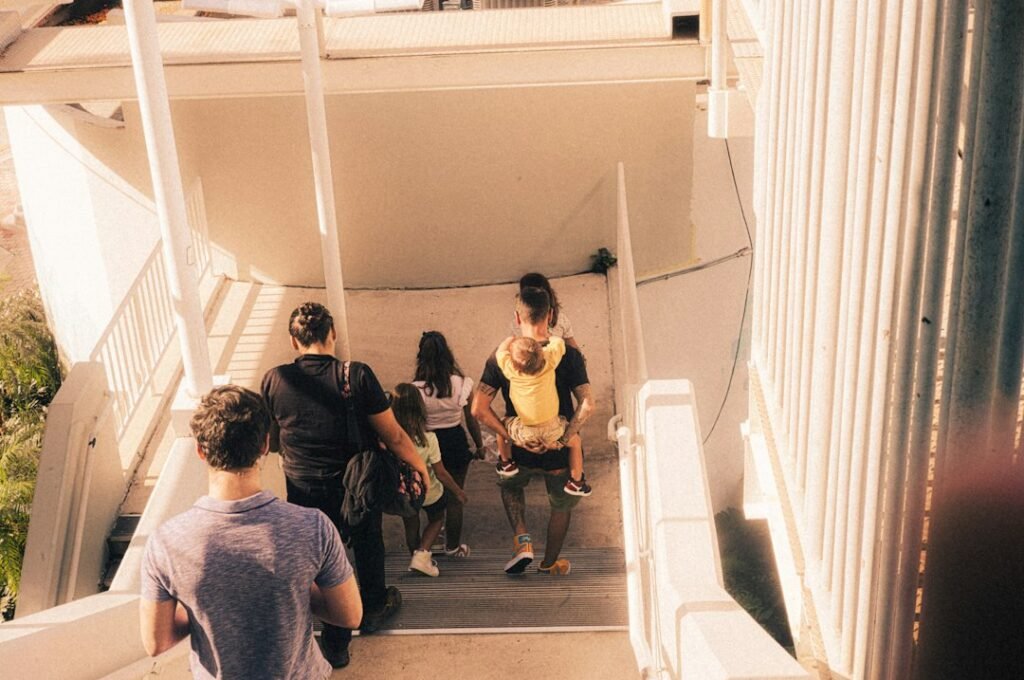
Narrow inner-city terraces and townhouses often force a staircase into a non-ideal zone due to lot width, but lighting, colour and a clear top-of-stairs focal point can meaningfully soften an unavoidable North or North-East placement.
Sydney’s terrace stock, particularly in the inner west and eastern suburbs, was rarely built with Vastu in mind, and I regularly work with clients whose staircase is fixed in a less-than-ideal position by the original architecture. In these cases full relocation usually isn’t realistic, so the correction strategy shifts to mitigation: bright, warm lighting along the full run rather than a single dim fixture at the top; a genuinely soothing colour on the stairwell walls (soft creams and warm neutrals rather than dark or cold tones); and something visually grounding at the top of the stairs — artwork, a plant, a warm light — so the eye and the energy both land on something settling rather than a blank wall or a bedroom door directly in line with the top step.
Astrologer’s Insight: I look at staircase corrections alongside a client’s Dasha period whenever finances are the presenting concern. A poorly placed staircase during a challenging Shani (Saturn) period tends to compound feelings of stagnation, while the same fix landing during a supportive Guru (Jupiter) period often produces a noticeably faster shift in mood and momentum around the home.
Staircase Placement at a Glance
This table summarises staircase directions from best to worst, so you can quickly assess your own home’s layout and prioritise corrections where they matter most.
| Staircase Zone | Vastu Rating | Effect on the Home |
|---|---|---|
| South-West | Excellent | Reinforces stability and grounded finances |
| South | Very Good | Supports strength and steady progress |
| West | Good | Generally neutral to positive with good lighting |
| North | Caution | Can dampen opportunity flow if heavy or enclosed |
| East | Caution | Best kept light and open if unavoidable here |
| North-East | Avoid | Blocks clarity and growth; correct wherever possible |
| Centre (Brahmasthan) | Avoid | Disrupts the home’s core energy; relocate if feasible |
Case Study
The Kellyville Family Whose New Staircase Turned Their Home Around
A Kellyville family came to me mid-renovation, already unhappy with a builder’s proposed staircase running straight up through the North-East corner of their new double-storey extension. They’d been experiencing unexplained financial setbacks in the existing home and were anxious not to carry the same pattern into the rebuild.
“Rajat asked us one question that changed everything: ‘What if we just flipped the plans and put the stairs where the pantry was?’ It cost us nothing extra and it solved the exact thing we were worried about.”
We worked with their architect before construction locked in, relocating the staircase to the South-West and adjusting the floor plan so the North-East corner stayed open as a light-filled reading nook instead. The change required no additional structural cost since it happened at the design stage. Eighteen months after moving in, the family reports a home that genuinely feels calmer, and their finances have stabilised alongside a supportive Jupiter transit that began shortly after the move.

If your renovation or new build is still on the drawing board, this is the ideal time to get staircase placement reviewed before it becomes a costly change later.
Read More Client Success Stories
Frequently Asked Questions About Staircase Vastu
➕ My staircase is already in the North-East. Do I need to demolish and rebuild it?
Not necessarily. Full relocation is the strongest fix, but if that’s not realistic, lighting corrections, keeping the space beneath genuinely open and clutter-free, and adding grounding elements like a stone or ceramic planter at the base can meaningfully soften the effect without structural work.
➕ Does a spiral staircase break any Vastu rules?
A tight spiral staircase is generally considered less favourable than a straight or L-shaped flight, particularly if it sits near the centre of the home, as it creates a concentrated, swirling energy pattern. If you already have one, keeping it well lit and positioned toward the South or West rather than the centre or North-East reduces most of the concern.
➕ Does the direction I face while climbing matter, or just the staircase’s location?
Both matter, but location carries more weight. Ideally you climb in a clockwise direction when viewed from above, which usually happens naturally when a staircase is placed in the South, West or South-West and rises toward the centre of the home.
➕ Is it worth getting staircase placement reviewed before signing off on renovation plans?
Yes, strongly. Staircase relocation after construction is one of the most expensive Vastu corrections to make, while adjusting it at the design stage, as with the Kellyville family above, typically costs nothing extra. A short consultation before plans are finalised is the highest-value time to act.
About the Author
Rajat is a Vedic Astrologer and Vastu Consultant at Astro Research, based in Sydney, where he has spent over fifteen years combining classical Jyotish training with practical, modern consultations for clients across Australia. He specialises in career timing, relationship compatibility and Vastu corrections for the home and workplace.
Planning a New Build or Renovation?
Get your staircase and floor plan reviewed before construction locks it in.