
Sthir Lagna and Navamsha: Why the Most Powerful Part of Your Lakshmi Puja Lasts About 16 Minutes
Every Diwali someone forwards a puja time to the family group, and everyone lights their lamps at once. In Sydney that time is usually wrong by two hours, and even the right two-hour window hides a smaller moment inside it, roughly sixteen minutes long, that traditional Muhurta treats as the heart of the puja.
Sthir Lagna means a fixed rising sign: Vrishabha (Taurus), Simha (Leo), Vrischika (Scorpio) or Kumbha (Aquarius). Lakshmi Puja is timed to a Sthir Lagna so that the wealth and grace you invite stay in the home. Navamsha divides that rising sign into nine parts of 3°20′ each, and the best of them, when Vrishabha rises in its own Navamsha, gives the strongest window of the evening.
Below I explain both ideas in plain language, show you how they work together, and give the actual windows for Diwali on Sunday 8 November 2026 in every Australian capital. Everything here is free to read and use.
• The four Sthir (fixed) Lagnas are Vrishabha, Simha, Vrischika and Kumbha.
• On Diwali evening the Sthir Lagna that matters is Vrishabha, and it must fall inside Pradosh Kaal, the first part of the night after sunset.
• Each Navamsha of Vrishabha lasts about 15 to 16 minutes in southern Australian cities.
• The 5th Navamsha of Vrishabha is both Vargottama and Pushkara, the strongest slice of the window.
• On Diwali night that slice lasts about 16 minutes in each Australian capital. Registered readers can see the exact times for every city below.
What is Sthir Lagna, and why does it matter for a puja?
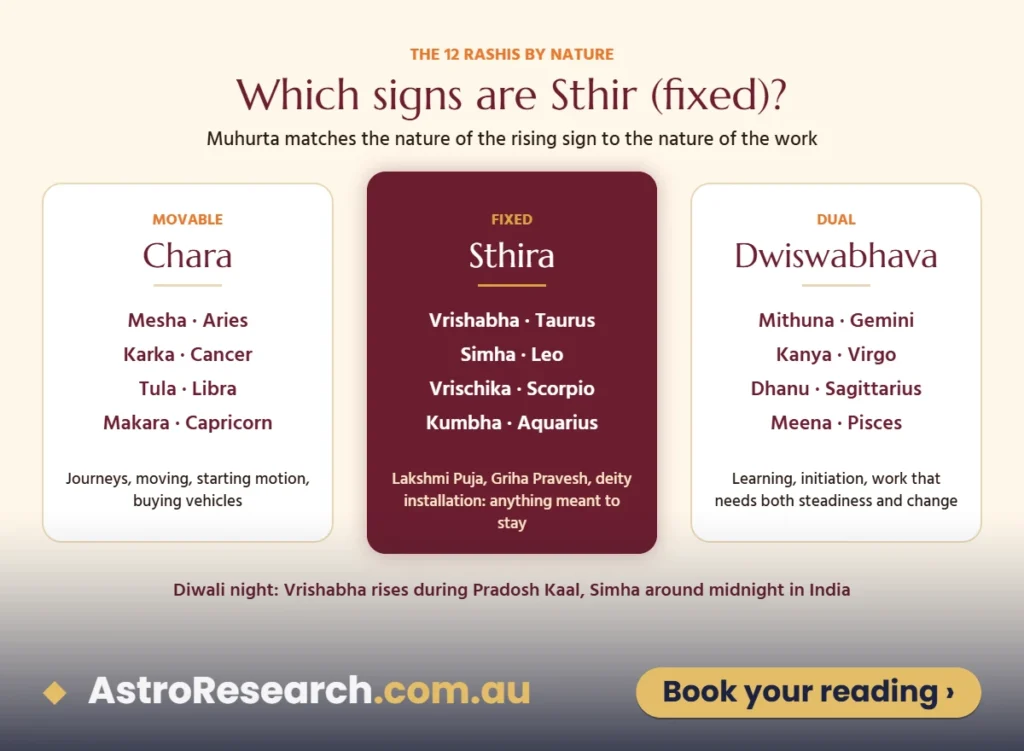
Lagna is the zodiac sign rising on the eastern horizon at a given moment, and it changes roughly every two hours. Muhurta, the Vedic science of timing, sorts the twelve signs into three natures, and a Sthir Lagna is one of the four fixed signs used for anything you want to last.
Classical Muhurta texts such as the Muhurta Chintamani give the Lagna more weight than any other factor, because a well-chosen rising sign is said to correct weaknesses elsewhere in the moment. The nature of the sign is matched to the nature of the work:
| Nature | Signs | Traditionally used for |
|---|---|---|
| Chara (movable) | Mesha, Karka, Tula, Makara | Journeys, moving house, starting anything that needs momentum |
| Sthira (fixed) | Vrishabha, Simha, Vrischika, Kumbha | Lakshmi Puja, Griha Pravesh, installing a deity, foundations, anything meant to stay |
| Dwiswabhava (dual) | Mithuna, Kanya, Dhanu, Meena | Learning, initiation, work that needs steadiness and flexibility |
Why is Lakshmi Puja done in a Sthir Lagna?
Lakshmi is traditionally called chanchala, the restless one, because wealth comes and goes. Worshipping her while a fixed sign rises is a symbolic and astrological way of asking her to settle in your home rather than pass through it.
Of the four fixed signs, Vrishabha is the favourite for the evening puja. It is ruled by Shukra (Venus), the planet of prosperity, comfort and beauty, and it is the sign where the Moon is exalted. On Diwali night in Australia, Vrishabha rises an hour or so after sunset, so it overlaps with Pradosh Kaal, the dusk period that the Diwali tradition prefers for Lakshmi Puja on Kartik Amavasya.
Panchang makers in India also list the other fixed Lagnas across the day: Vrischika in the morning and Kumbha in the afternoon, which some business families use for Chopda Pujan, and Simha around midnight for those who keep a night-time puja. Drik Panchang’s Diwali page lists all four for Indian cities. In Australia the times are completely different, as you will see below.
What is Navamsha, and how does it sharpen the Muhurat?
Navamsha means one-ninth. Each 30° sign is divided into nine parts of 3°20′, so while the Lagna changes about every two hours, the rising Navamsha changes about every 13 to 16 minutes. Muhurta uses it to pick the best part of a good Lagna, not just any part of it.
You may know the Navamsha as the D9 chart used for marriage and inner strength in a birth chart; I explain that use in my guide to the Navamsa (D9) chart. In Muhurta the same division works like a magnifying glass on the rising sign. Three kinds of Navamsha are prized:
- Vargottama Navamsha: when the rising sign and its Navamsha are the same sign. For fixed signs this is always the 5th Navamsha (13°20′ to 16°40′). The Lagna is then doubly strong, the same sign in both charts.
- Pushkara Navamsha: specific Navamshas regarded as nourishing. For Vrishabha they are the 3rd (Meena) and the 5th (Vrishabha). For Simha they are the 7th (Tula) and the 9th (Dhanu).
- Sthir Navamsha: a Navamsha that is itself a fixed sign. Inside Vrishabha these are the 2nd (Kumbha), 5th (Vrishabha) and 8th (Simha). They repeat the theme of steadiness.
Put those together and one slice stands out: the 5th Navamsha of Vrishabha is Vargottama, Pushkara and Sthir at once. That is why I call it the heart of the Lakshmi Puja window.
For Vrishabha, the nine Navamshas run in this order: Makara, Kumbha, Meena, Mesha, Vrishabha, Mithuna, Karka, Simha, Kanya. Earth signs always begin their Navamsha count from Makara; fire signs from Mesha, air signs from Tula and water signs from Karka.
When are the Navamsha windows for Diwali 2026 in each Australian city?
Does Simha Lagna still meet Nishita Kaal in Australia?
How do you use these windows for your puja at home?
Do Sthir Lagna and Navamsha apply to Dhanteras, Karwa Chauth and other poojas?
What mistakes do families make with Diwali puja timing abroad?
Questions people ask about Sthir Lagna, Navamsha and puja timing
These are the questions I see again and again on Quora, in community groups and from my own clients.
What is Sthir Lagna in simple words?
Sthir Lagna is a period when one of the four fixed zodiac signs, Vrishabha, Simha, Vrischika or Kumbha, is rising on the eastern horizon. Each lasts about two hours. Muhurta uses these periods for anything meant to be permanent, such as Lakshmi Puja, moving into a new home or installing a deity.
Why is Lakshmi Puja done at night and not in the morning?
Diwali falls on Amavasya, the new moon, and the tradition is that Maha Lakshmi visits homes after dusk that night. The puja is therefore placed in Pradosh Kaal, the period just after sunset, and ideally when the fixed sign Vrishabha is rising, so that prosperity stays. Morning worship is fine on other days, but Diwali’s Lakshmi Puja is an evening rite.
Is Lagna the same as Navamsha?
No. The Lagna is the whole rising sign, which lasts about two hours. The Navamsha is one-ninth of that sign, which lasts about 13 to 16 minutes. In Muhurta, the Lagna sets the broad window and the Navamsha picks the strongest part of it.
What does Vargottama mean in a Muhurat?
Vargottama means the rising sign and its Navamsha are the same sign, for example Vrishabha rising in the Vrishabha Navamsha. The Lagna is then considered doubly strong, much like a birth chart where a planet sits in the same sign in both the main chart and the Navamsha. For fixed signs the Vargottama portion is always the 5th Navamsha, from 13°20′ to 16°40′.
What is Pushkara Navamsha?
Pushkara Navamshas are specific ninth-parts of each sign that tradition treats as nourishing and supportive, a little like a blessing on top of a good Lagna. For Vrishabha they are the 3rd (Meena) and 5th (Vrishabha) Navamshas. Many astrologers prefer to begin an important rite in a Pushkara Navamsha when one is available inside the main window.
Do I have to finish the puja inside the Muhurat, or is starting enough?
The tradition is that the Sankalpa and the main invocation should be made inside the Muhurat. Once the deity has been invited at the right moment, the rest of the worship can continue past the end of the window. That is why I suggest placing the Sankalpa and Lakshmi Avahan inside the best Navamsha and finishing the aarti before Pradosh Kaal ends if you can.
What if I miss the Sthir Lagna window on Diwali?
Perform the puja anyway, with full devotion, as soon as you can that night while Amavasya continues. Many families also keep a second Sthir Lagna, Simha, late in the night, although in Australia it rises after Nishita Kaal. Missing the ideal moment never cancels sincere worship.
How long should a Lakshmi Puja take?
A simple home Lakshmi-Ganesha puja with Sankalpa, invocation, offerings, a stotra and aarti usually takes 45 to 75 minutes. If you start the Ganesha puja early in Pradosh Kaal, you will reach the Lakshmi Avahan comfortably inside the best Navamsha.
In what order should the Lakshmi-Ganesha puja be done?
The usual order is purification, Ganesha puja, Kalash Sthapana, Navagraha worship, then the Sankalpa and invocation of Lakshmi, her offerings, a stotra such as Shri Suktam, Kubera and Saraswati worship if your family includes them, and finally the aarti. Ganesha is always worshipped first so that the rite proceeds without obstacles.
Should I follow Indian time or local time for Diwali puja abroad?
Always local time. Lagna, Navamsha and Pradosh Kaal depend on your own sunrise, sunset and latitude, so a time calculated for New Delhi means nothing in Sydney or Perth. The festival date can match India while the puja window is hours apart.
Why are Diwali dates and timings different in North and South India?
North and South India use different month systems, Purnimanta and Amanta, which changes month names but rarely the Diwali date itself. The bigger difference is emphasis: much of South India celebrates Deepavali on Naraka Chaturdashi morning, while the North centres on Lakshmi Puja on Amavasya evening. Timings also differ because every city has its own sunset and rising signs.
Can I do Lakshmi Puja at home without a priest?
Yes. Most families perform the Diwali Lakshmi Puja themselves. What you need is the right timing for your city, the Samagri ready in advance and a reliable Puja Vidhi to follow. My festive pooja guides give you all three, calculated for your suburb.
How were these timings calculated?
Get your own Diwali Muhurat, calculated for your suburb
A Vedic Pandit can calculate your whole Diwali timeline for your own suburb: Pradosh Kaal, Sthir Lagna, the Navamsha slices, Nishita Kaal and the Choghadiya, with a complete Samagri checklist and a step-by-step guide to the Puja Vidhi. See all four festive poojas, with dates and prices, on the festive pooja Muhurat page, or book the Diwali Lakshmi-Ganesha Pooja guide directly. If you’d like me to look at your own chart for the year ahead, book a Vedic astrology consultation.
Puja timings are traditional spiritual guidance offered in good faith. Their effects are personal and can’t be guaranteed, and they are not a substitute for financial, medical or legal advice.